
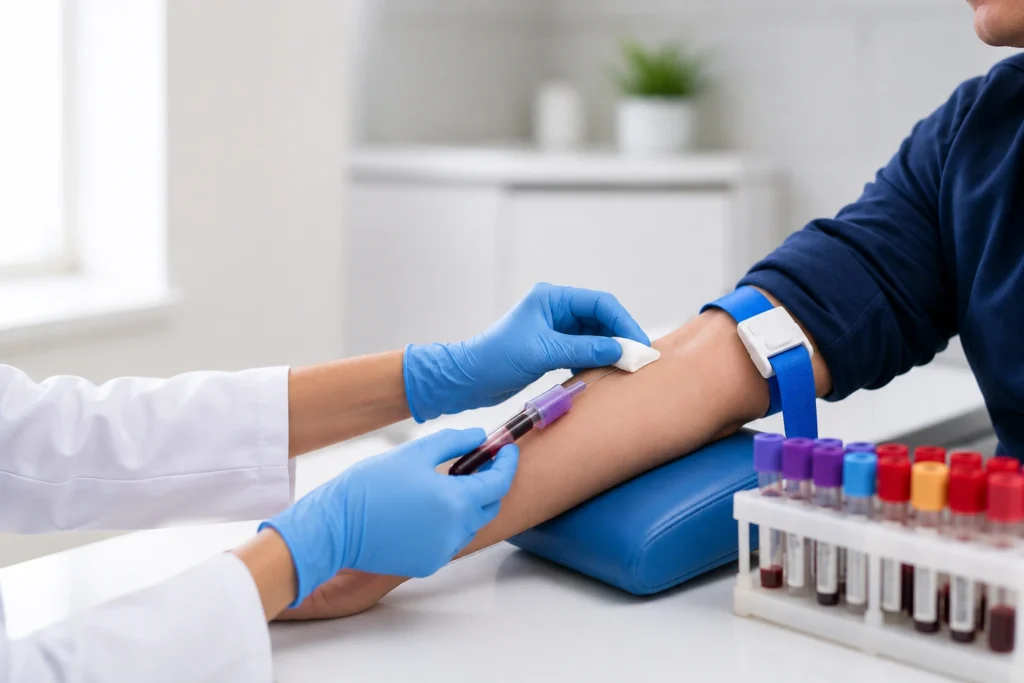
Every year, millions of NHS patients sit down, roll up their sleeve, and hand over a small vial of blood often without fully understanding what happens next, or why. This guide explains phlebotomy from first principles, written by a registered GMC doctor who orders these tests every single day.
In This Article
Phlebotomy: What Does the Word Actually Mean?
Phlebotomy is the clinical practice of drawing blood from a vein — most commonly from the inside of the elbow, the back of the hand, or the wrist. In everyday British English, most people simply call it “having a blood test,” but phlebotomy is the proper medical term used throughout the NHS.
The word comes from ancient Greek: phlebos meaning “vein” and tomia meaning “cutting.” It passed into English via Old French as flebothomie and has been used in medicine for centuries — though the practice today is far safer, far less painful, and far more precise than anything our ancestors would recognise.
Simple Definition of phlebotomy
Phlebotomy is the process of making a small puncture in a vein — usually in the arm — to withdraw a blood sample for laboratory testing, donation, or treatment. The person trained to do this is called a phlebotomist.
Phlebotomy vs Venepuncture — What’s the Difference?
These two terms cause a fair bit of confusion, even amongst healthcare staff. Here is the distinction as I explain it to my students:
Venepuncture refers specifically to the needle-into-vein technique — the physical act of puncturing the vein to access it. Phlebotomy is the broader clinical role: it encompasses venepuncture, but also includes patient communication, selecting the correct sample tubes, labelling, and dispatching samples to the laboratory. Think of venepuncture as the move, and phlebotomy as the whole game.
What About Therapeutic Phlebotomy?
Most phlebotomy done in the NHS is diagnostic — blood is drawn so that it can be analysed. However, therapeutic phlebotomy is something rather different: it involves deliberately removing a significant volume of blood (usually around 450–500 ml, roughly a pint) as a treatment in its own right.
This is used for conditions such as haemochromatosis (iron overload disorder) and polycythaemia vera (too many red blood cells), where the excess needs to be reduced to protect organs. It is essentially the modern, evidence-based descendant of historical bloodletting — though the science behind it today is far more rigorous.
Doctor’s Note
“When patients ask me what phlebotomy is, I say it simply: it’s the safest, quickest, and most informative five minutes in medicine. A tiny vial of your blood can reveal more about what’s going on inside your body than almost any other test we have.”
Why Is Phlebotomy Done? The Most Common Reasons Your GP Requests a Blood Test
Blood tests are amongst the most frequently requested investigations in the entire NHS. Your GP, consultant, or nurse might ask for a phlebotomy appointment for any of the following reasons:
1. Diagnosis
Blood tests can identify infections, detect anaemia, diagnose diabetes, reveal thyroid problems, uncover liver disease, and flag dozens of other conditions — often before you feel unwell. A well-chosen panel of blood tests is frequently the first step in working out what is actually wrong.
2. Monitoring Ongoing Conditions
Many long-term conditions require regular blood monitoring to ensure treatment is working and the body is coping safely. For example: kidney function tests in patients with chronic kidney disease (CKD), INR checks in patients taking warfarin, HbA1c monitoring in diabetics, and thyroid function tests in patients on levothyroxine.
3. Routine Screening
The NHS uses blood tests as part of health checks for conditions like high cholesterol, type 2 diabetes, and cardiovascular risk. Full blood count (FBC) screens are also routinely requested to check for anaemia, infection, or blood disorders.
4. Pre-Operative Assessment
Before any surgical procedure, the clinical team needs to know that your blood is clotting normally, your kidneys can process anaesthetic drugs, and that you are not anaemic. Pre-op bloods are a standard requirement across NHS trusts.
5. Blood Donation
NHS Blood and Transplant (NHSBT) collects blood from voluntary donors across the UK, which is used for transfusions during surgery, trauma care, cancer treatment, and childbirth. Donating blood is a form of therapeutic phlebotomy, administered in a controlled and voluntary setting.
6. Therapeutic Treatment
As described above, conditions such as haemochromatosis and polycythaemia require regular removal of blood as their primary treatment. Without phlebotomy, iron accumulates and damages the liver, heart, and joints.
1bn+
Blood tests processed by NHS labs annually
~70%
Of clinical decisions influenced by lab results
2–5
Minutes for most blood draws
24–72h
Typical turnaround for routine results
Doctor’s Note
“I have ordered phlebotomy tests on the same patient for six entirely different reasons in a single year. Blood testing sits at the heart of diagnostic medicine in the NHS — without it, we would be largely guessing.”
What Happens During a Phlebotomy Procedure? A Step-by-Step Guide
Understanding exactly what will happen can make the experience considerably less daunting. Here is the full process, from booking your appointment to walking back out the door.
Before Your Appointment
- ✓Check whether your test requires fasting. If your GP hasn’t told you, ring the surgery — it matters for glucose, lipid, and HbA1c tests.
- ✓Drink a full glass of water beforehand (unless fasting is required for your specific test). Proper hydration plumps up your veins and makes the draw significantly easier.
- ✓Bring your blood test request form — your GP will have given you one, or it may be electronic. You will also need your NHS number at many clinics.
- ✓Wear loose-fitting clothing or a top with sleeves that roll up easily.
- ✓If you have a needle phobia or have fainted during blood tests before, tell the clinic when you book — they can prepare appropriately.
At the Clinic
You will check in at reception and your details will be verified. The phlebotomist will confirm your name, date of birth, and the tests being requested before anything else happens. This is not a formality — accurate patient identification prevents potentially serious errors.
The Blood Draw Itself
-
1
Positioning
You will be seated with your arm extended and supported. Some patients prefer to lie down — this is entirely acceptable and sensible if you are prone to feeling faint.
-
2
Tourniquet
A soft rubber band is applied above the elbow to increase pressure in the vein and make it more visible and accessible. You may be asked to clench your fist.
-
3
Vein selection and skin cleaning
The phlebotomist will gently feel for the most suitable vein — usually the median cubital vein in the crook of the elbow — and clean the area with an alcohol wipe. They will allow it to dry before proceeding.
-
4
Needle insertion
A sterile needle is inserted smoothly at a slight angle into the vein. This is the moment most people notice — a brief, sharp scratch lasting one to two seconds. The tourniquet is released once the vein is accessed.
-
5
Sample collection
Blood is drawn into one or more colour-coded sample tubes. Each tube contains specific additives designed to preserve the sample for its particular test. The phlebotomist works quickly and methodically.
-
6
Needle removal and pressure
Once the required samples have been collected, the needle is removed and firm pressure is applied to the site with a gauze pad. You will be asked to maintain that pressure until the bleeding stops.
-
7
Plaster and labelling
A small adhesive plaster is applied. Your samples are labelled immediately at the bedside — NHS policy requires this in your presence — and sent to the laboratory.
Hydration Tip
Drinking 500 ml of water in the hour before your appointment (unless fasting is required) can make a real difference to how easy your veins are to access. Dehydrated veins collapse under the needle — well-hydrated veins stay open and visible.
What If I Have Difficult Veins?
Some patients — particularly the elderly, those who are very slim, or those who have had repeated intravenous treatments — have veins that are hard to find or access. This is extremely common and nothing to feel embarrassed about.
Phlebotomists are trained to use a butterfly needle (a smaller, winged device that can access finer veins at a more precise angle) in these situations. Under NHS policy, each phlebotomist is permitted a maximum of two attempts per patient. If both are unsuccessful, a colleague will take over rather than continuing to cause discomfort.
Doctor’s Note
“I always advise patients to drink a full glass of water before attending their phlebotomy appointment. It is the single simplest thing you can do to make the experience quicker, easier, and more comfortable — and it costs absolutely nothing.”
Who Performs Phlebotomy in the UK?
In the NHS, phlebotomy can be performed by a range of trained healthcare professionals. Most of the time, however, you will be seen by a dedicated phlebotomist.
Phlebotomists
Specialist phlebotomists are the backbone of NHS blood testing services. They work predominantly at NHS Band 2 to Band 3 on the Agenda for Change pay scale — starting at £24,465 per year in 2025/26. Their sole clinical focus is the safe and efficient collection of blood samples, and an experienced phlebotomist is frequently better at difficult draws than a junior doctor.
Nurses, Healthcare Assistants, and Doctors
Registered nurses, healthcare assistants with appropriate training, and doctors all perform phlebotomy as part of their wider clinical roles — particularly in inpatient settings, GP surgeries, and acute care environments where a dedicated phlebotomist may not always be present.
Where Do They Work?
- ✓NHS hospital phlebotomy departments and outpatient pathology clinics
- ✓GP surgeries (often running dedicated phlebotomy clinics one or two days a week)
- ✓Community Diagnostic Centres (CDCs) — an NHS England initiative expanding access
- ✓NHS Blood and Transplant donation centres
- ✓Private clinics, pharmacies, and independent blood testing services
- ✓Patients’ homes — for housebound individuals, by prior arrangement with the GP
Training and Qualifications
There is no single mandatory qualification to become a phlebotomist in the UK, though the most widely recognised route is the Level 3 Award in Phlebotomy (regulated by Ofqual). NHS trusts also run in-house training programmes and phlebotomy apprenticeships. CPD-accredited one-day courses provide the theoretical foundation, but employers typically require supervised live-draw experience — usually five to eight observed and assessed venepunctures — before a candidate is permitted to work independently.
Doctor’s Note
“A skilled phlebotomist can locate a difficult vein in seconds — faster than many of my junior colleagues could manage. It is a genuinely specialist clinical skill, and one that deserves far more recognition than it typically receives.”
Where to Get a Blood Test in the UK — NHS vs Private
The NHS Route (Free at the Point of Use)
The vast majority of blood tests in the UK are carried out through the NHS, free of charge, following a referral from your GP, hospital consultant, or another healthcare professional. Your GP will issue a blood test request form (either paper or electronic), which you take to your local phlebotomy service.
Booking is typically done online through your NHS trust’s portal, via NHS apps such as Swiftqueue, or by telephone. You will need to bring your request form and your NHS number. Results are sent to your GP and — for most tests — are viewable on the NHS App once reviewed.
What to Bring to an NHS Blood Test
Your blood test request form from your GP · Your NHS number (on your NHS App or medical letters) · Photo ID if attending a new clinic · A list of any medications you take, if asked
Community Diagnostic Centres (CDCs)
NHS England has been expanding its network of Community Diagnostic Centres — standalone facilities separate from hospital sites that offer diagnostic services including phlebotomy, imaging, and physiological tests. CDCs are specifically designed to reduce waiting times and improve local access. Many now operate extended hours, including evenings and weekends.
Private Blood Testing
If you do not wish to wait for an NHS referral, or if you want to test for something not routinely available on the NHS, private phlebotomy services are widely available across the UK. Providers include:
- ✓Medichecks — postal test kits and clinic appointments, wide range of panels
- ✓Bupa Health Clinics — GP and nurse-led private health assessments
- ✓National Blood Test Clinic — accredited private phlebotomy clinics across the UK
- ✓Boots Pharmacy and other high-street pharmacies — basic health check blood tests
Important
Private blood test results are not automatically shared with your NHS GP. If you receive an abnormal result through a private service, always contact your GP surgery to discuss it and ensure it is recorded in your NHS notes.
Doctor’s Note
“My strong advice is always to use the NHS route first. Not only is it free, but your results feed directly into your medical record, which means any abnormalities can be actioned quickly and in the full context of your history. Private testing has its place — but it should complement NHS care, not replace it.”
Common Blood Tests Explained — and the Colour-Coded Tubes They Use
When the phlebotomist draws your blood, they collect it into specific colour-coded tubes. Each colour indicates a different additive inside the tube, which helps preserve the sample or prepare it for a particular type of analysis. Here are the most common tests you are likely to be sent for, and which tubes they use:
| Tube Colour | Additive | Common Tests | What It Checks |
|---|---|---|---|
| Purple / Lavender | EDTA | Full Blood Count (FBC) | Red cells, white cells, platelets, haemoglobin |
| Gold / SST | Clot activator + gel | U&E, LFTs, TFTs, lipids, CRP, HbA1c | Kidney, liver, thyroid function; cholesterol; inflammation; diabetes |
| Blue | Sodium citrate | Coagulation screen, INR, PT, APTT | Blood clotting — essential for warfarin monitoring and pre-op checks |
| Green | Heparin (sodium or lithium) | Blood gas analysis, some biochemistry | Acid-base balance, electrolytes in critical care |
| Grey | Fluoride oxalate | Fasting glucose, GTT (glucose tolerance test) | Diabetes diagnosis and monitoring; preserves glucose in sample |
| Orange / Red | None or clot activator | Serology, blood bank, crossmatch | Infection markers, blood group typing, transfusion compatibility |
The Most Common Tests You Will Encounter
Full Blood Count (FBC) — the most frequently requested blood test in the NHS. It measures the quantity and quality of red blood cells (carrying oxygen), white blood cells (fighting infection), and platelets (clotting). Abnormalities can indicate anaemia, infection, leukaemia, or clotting disorders.
Urea & Electrolytes (U&E) — checks kidney function and electrolyte balance. Sodium, potassium, urea, and creatinine are the key values. Essential for monitoring patients on certain medications and those with heart or kidney conditions.
Liver Function Tests (LFTs) — measures enzymes and proteins produced by the liver. Useful in diagnosing hepatitis, fatty liver disease, gallbladder problems, and monitoring alcohol-related liver damage.
Thyroid Function Tests (TFTs) — measures TSH (thyroid-stimulating hormone) and, where indicated, T3 and T4. Used to diagnose and monitor both underactive (hypothyroidism) and overactive (hyperthyroidism) thyroid conditions.
HbA1c — reflects average blood glucose over the preceding two to three months. This is the gold standard test for diagnosing and monitoring type 2 diabetes, and does not require fasting.
Lipid Profile — measures total cholesterol, LDL (“bad” cholesterol), HDL (“good” cholesterol), and triglycerides. Used to assess cardiovascular risk. Fasting is typically required for this test.
C-Reactive Protein (CRP) — a non-specific marker of inflammation and infection. A raised CRP tells us the body is fighting something, though it does not tell us what.
Understanding Your Blood Test Results in the UK
Having blood taken is only half the story. What happens next — how your results are interpreted and communicated — is often what patients feel least prepared for.
Who Interprets Your Results?
The phlebotomist collects your blood. The laboratory scientist analyses it. But it is your GP, hospital consultant, or specialist nurse who interprets the results in the context of your individual health, your symptoms, your medications, and your history. This is a critical distinction: a result that looks alarming in isolation may be entirely expected given your clinical circumstances — and only your doctor can make that judgement.
Viewing Results on the NHS App
As of 2025, most routine blood test results are visible on the NHS App at the same time as they are sent to your GP — usually within 24 to 72 hours for routine tests. A small number of sensitive results (such as certain cancer markers or HIV tests) are withheld for a period to allow your GP to contact you first.
Seeing your results before your doctor has had a chance to review them can be anxiety-provoking. If you see a flagged result and feel concerned, contact your surgery for a call-back or a review appointment rather than attempting to interpret it alone.
Understanding Reference Ranges
Every result on your blood test report comes with a reference range — the values considered normal for the laboratory running the test. Being outside this range does not automatically mean something is wrong; reference ranges are based on population statistics and around 5% of completely healthy people will fall outside them simply by chance.
More importantly, trends over time often matter far more than a single abnormal reading. A haemoglobin result that has dropped steadily over six months is clinically far more significant than one that is slightly low on a single occasion.
How Long Do Results Take?
- ✓Routine bloods (FBC, U&E, LFTs): typically 24–48 hour
- ✓More complex panels (hormone levels, specialist markers): 48–72 hours
- ✓Microbiology and culture results: 3–7 days
- ✓Genetic testing: several weeks
Doctor’s Note
“Context is everything in blood test interpretation. I have had patients ring me in a panic about a slightly raised CRP — which turned out to reflect nothing more sinister than a mild cold the week before. Always speak to your doctor before drawing conclusions from numbers on a screen.”
Frequently Asked Questions
Most patients feel a brief, sharp scratch when the needle is inserted — lasting no more than one to two seconds. After that, you may feel a mild sensation of pressure as the blood is drawn, but this should not be painful. Any soreness or bruising at the site afterwards typically resolves within a few days. If you are particularly anxious about needles, let your phlebotomist know — they are experienced in helping nervous patients and can use techniques to minimise discomfort.
It depends entirely on which test has been requested. Fasting is required for glucose tests, HbA1c (in some protocols), and lipid profiles — typically nothing to eat or drink except plain water for 8 to 12 hours beforehand. For most other blood tests, including a full blood count, kidney function, and thyroid tests, fasting is not required. Your GP’s request form or letter will specify if fasting is needed. If you are unsure, ring the surgery before your appointment rather than guessing.
Yes — through private services. Companies such as Medichecks, Bupa, and The National Blood Test Clinic allow you to self-refer and pay for blood tests without needing a GP referral. Costs vary widely depending on the panel requested. However, NHS blood tests remain free at the point of use and require a request form from your GP, nurse, or hospital consultant. For most people, the NHS route is both the most cost-effective and the most clinically coordinated option.
Under NHS policy, each individual phlebotomist is permitted a maximum of two venepuncture attempts per patient per session. If both attempts are unsuccessful, they must not continue — another staff member will take over, starting fresh with a different technique or site. This policy exists to protect patients from unnecessary discomfort and to maintain dignity of care. If you have notoriously difficult veins, it is worth mentioning this when you arrive so the phlebotomist can plan accordingly.
No — they are essentially the opposite. Phlebotomy involves withdrawing a small amount of blood from your body for testing or therapeutic reasons. A blood transfusion involves receiving donor blood into your body, used to treat conditions such as severe anaemia, significant blood loss during surgery or trauma, or certain medical conditions. The two procedures serve very different clinical purposes, though both involve accessing a vein.
The blood draw itself usually takes between two and five minutes — often less for straightforward cases. However, you should allow more time for check-in, waiting, and any paperwork. Most NHS phlebotomy clinics run on an appointment basis and aim to see patients promptly. Walk-in clinics may involve a longer wait, particularly during busy morning periods.
A Community Diagnostic Centre is an NHS facility — separate from a traditional hospital site — that provides a range of diagnostic tests including blood tests, MRI and CT scans, X-rays, and physiological measurements. They were established as part of NHS England’s plan to reduce waiting lists, improve access, and bring diagnostic services closer to where patients live. Many CDCs offer extended opening hours including evenings and Saturdays. Your GP can refer you directly to your local CDC.
Summary — What You Need to Know About Phlebotomy in the UK
Phlebotomy is the clinical process of drawing blood from a vein for laboratory testing, donation, or treatment. It is safe, quick, and sits at the foundation of modern diagnostic medicine. Here is what to take away from this guide:
- ✓Phlebotomy and venepuncture refer to the same general process — venepuncture is the needle technique; phlebotomy is the broader clinical role.
- ✓Blood tests are used to diagnose illness, monitor treatment, screen for disease, and in some cases to treat medical conditions directly.
- ✓The procedure itself takes two to five minutes. The most common sensation is a brief, sharp scratch.
- ✓Drinking water beforehand and wearing loose-sleeved clothing are simple steps that make the experience easier for everyone.
- ✓NHS blood tests are free at the point of use — always use this route first unless you have a specific reason to go private.
- ✓Results are typically available within 24 to 72 hours and are viewable on the NHS App for most routine tests.
- ✓Always discuss abnormal results with your GP before drawing conclusions — context is everything.
Final Word from the Doctor
“If your GP has asked you to have a blood test, please go. It is a small investment of your time that can provide enormous clinical insight. The earlier we find things, the more effectively we can treat them — and a blood test is almost always the first step in getting you the answers you need.”